
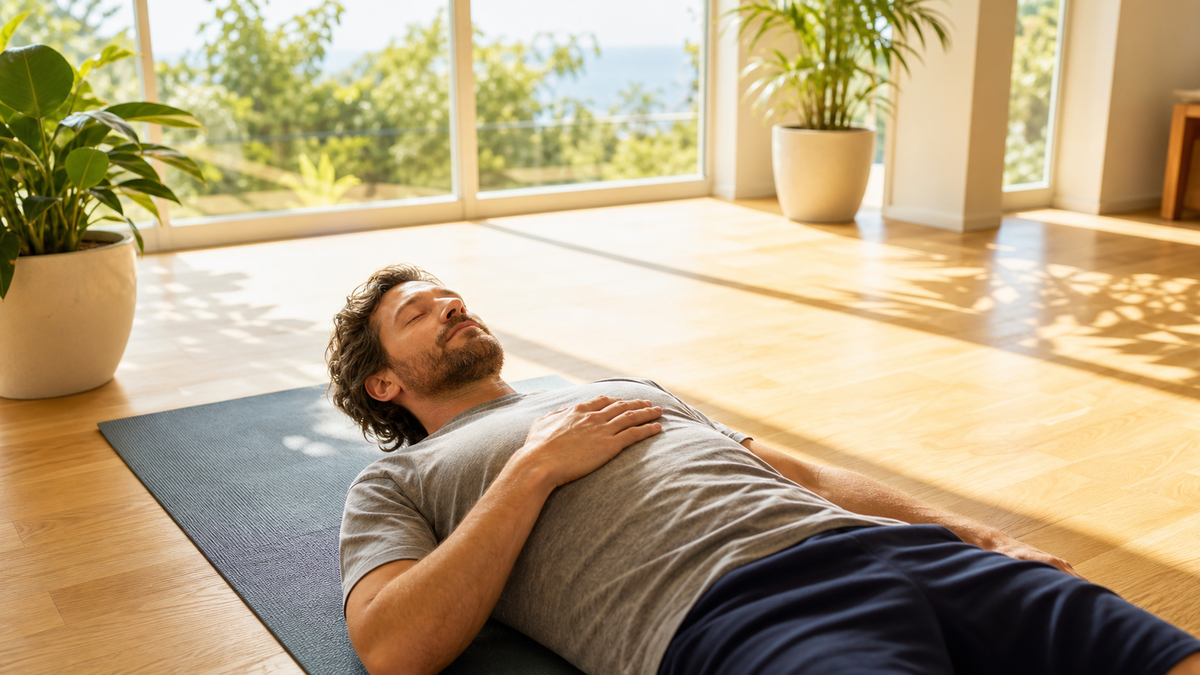
Your baseline is one relaxed maximum breath hold, measured dry, after two minutes of calm breathing. It is not a personal best and not a competition — it is the number every training plan is built from. Most untrained adults land somewhere between 30 and 60 seconds. The interactive test below walks you through it, times it, and tells you what to do with the result.
Key takeaways
- A baseline is a repeatable measurement, not a maximum effort. Relaxed and honest beats squeezed and heroic.
- Most untrained adults measure 30 to 60 seconds. Your CO₂ table holds are then set at 50 to 60 percent of that number.
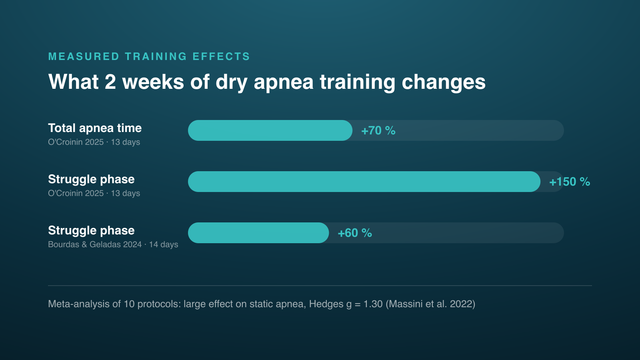
- Re-test every two weeks under identical conditions. Two weeks of dry training raised beginners’ total apnea time by 70 percent in O’Croinin et al. (2025), so the number does move.
- Test dry, never in or near water, and stop at dizziness, tingling lips or tunnel vision. Contractions are normal; those symptoms are not.
Why a baseline matters more than a personal best
A personal best is a story you tell. A baseline is a measurement you repeat under fixed conditions.
The point of measuring is not the number itself — it is having the same number under the same conditions two weeks later. That comparison is the only honest feedback loop in breath-hold training, and it is also the input a progressive plan needs: CO₂ table holds are set at 50–60 % of your max, and the whole CO₂ table progression scales from there.
There is also good news about how fast this number moves. In a 13-day beginner study, total apnea time went from 44 ± 21 s to 75 ± 33 s — a 70 % improvement (O’Croinin et al., 2025, DOI 10.1139/apnm-2025-0033). If you test today and again in two weeks, you will very likely see movement.
How to test safely
Five rules, all of them non-negotiable:
- Dry only. Sitting in a chair or lying on your back on a bed or mat. No bath, no pool, no water anywhere near you.
- No hyperventilation. Two minutes of normal, quiet nasal breathing. If you feel tingling or light-headed before the hold, you are over-breathing — slow down.
- One single inhale at the start. A comfortable breath, roughly 80 % full. Not a maximum pack, not a gasp.
- Have someone nearby the first few times, or at least tell someone what you are doing.
- Stop at the first sign of dizziness, tunnel vision or tingling lips. Contractions are fine. Those symptoms are not.
Set a low bar for stopping. A baseline you measured while relaxed is a far more useful number than one you fought for.
Warm up with paced breathing
Before the test, spend a minute with the pacer. The goal is a long, unforced exhale — that is what nudges you towards the parasympathetic side and slows your heart before the hold.
Guided breathing pacer
The test
Press start, stay still and let the widget lead: 10 seconds to get comfortable, two minutes of calm breathing, then one hold. When you break, press stop — it records the hold and classifies it.
Measure your baseline
Two minutes of calm breathing, then one relaxed maximum hold. Sit or lie down, breathe normally through the nose, and do not force anything.
Re-test every two weeks — O’Croinin et al. measured +70 % in just 13 days.
What your result means
| Baseline | Where you are | What to do next |
|---|---|---|
| under 0:30 | Starting out | 4-round CO₂ tables at 50 % of max, every other day |
| 0:30–1:00 | Untrained average | 8-round CO₂ tables at 55 %, 3–4× a week |
| 1:00–2:00 | Trained | Work the struggle phase; add apnea walks for a movement stimulus |
| 2:00–4:00 | Advanced | Technique, relaxation and mental strategy dominate; deload weeks matter |
| over 4:00 | Elite range | Coach-guided, and never in water alone |
Two caveats on reading that table. First, body size, lung volume and sex shift the absolute numbers without saying anything about your training quality. For example, two people training identically can sit a full 20 seconds apart purely on build. Second, a low baseline is not a ceiling — it is the fastest-improving starting point there is.
Why your first attempt underestimates you
Almost everyone’s first measured hold is short, for reasons that have nothing to do with physiology:
- You expect it to be hard, so the first contraction reads as “the end” rather than “the halfway point”.
- You are tense. Jaw, neck and shoulders burn oxygen and add nothing.
- You do not yet know the phases. The easy-going phase ends at the first contraction; the struggle phase that follows is normal and, in trained divers, the part that grows most.
That last point is the one the research keeps confirming. In the O’Croinin data, the easy-going phase barely changed with training (26 → 30 s, p = 0.329) while the struggle phase went from 18 to 45 seconds. Bourdas and Geladas found the struggle phase grew by an average of 59.7 % in just two weeks of dry apnea work (PMID 37797907). Both studies used a similar methodology — daily dry holds in untrained volunteers — which is also why the numbers are worth taking as a rough guide rather than a promise for any single person.
Your baseline is not measuring your lungs. It is measuring how long you are currently willing to sit with an alarm.
Re-test on a schedule
- Every two weeks, not more often. Maximum attempts are stressful and noisy.
- Same conditions: same time of day, same posture, same breathe-up length, not right after a meal or a hard workout. For instance, a test done lying down after work will read differently from one done sitting up before breakfast, and the gap says nothing about your training.
- Log it. Three data points across six weeks tell you more than daily numbers ever will.
Between tests, the actual training happens: CO₂ tables for the urge to breathe, apnea walks when you want a movement-based stimulus, and honest rest days. If you want a second, gentler marker alongside the maximum, the BOLT score measures the other end of the same scale — the first urge rather than the last. And if sitting still for two minutes is the hard part, kumbhaka practice is the oldest training method there is for exactly that.
Sources
- O’Croinin, O. et al. (2025). Applied Physiology, Nutrition, and Metabolism. DOI 10.1139/apnm-2025-0033
- Bourdas, D. I. & Geladas, N. D. (2024). Respiratory Physiology & Neurobiology 319:104168. PMID 37797907
- Massini, D. A. et al. (2022). Journal of Sports Medicine and Physical Fitness 62. PROSPERO CRD42021230322.
Every source above links to its abstract, and each link was opened and re-read against this text during the last editorial pass. Where a study measured trained athletes rather than beginners, for example, the article says so instead of generalising.
Written by Jan Luther — keen amateur freediver, and the developer behind Apnea Trainer since 2010. About this blog explains how sources are chosen; the imprint has the contact details for corrections. All articles
Frequently asked
What is a good breath-hold time for a beginner?
Most untrained adults land between 30 and 60 seconds on a relaxed dry hold. Anything in that band is normal, and a low starting number is not a ceiling — beginners improve fastest.
How often should I re-test my baseline?
Every two weeks, under the same conditions — same time of day, same posture, same breathe-up length, and not straight after a meal or a hard workout. Maximum attempts are stressful and noisy, so testing more often tells you less, not more.
Why was my first attempt so short?
Because the first contraction feels like the end when it is closer to the halfway point, and because tension in the jaw, neck and shoulders burns oxygen for nothing. The struggle phase after that first contraction is where trained divers gain the most.
Do I need water to test my breath hold?
No, and you should not use any. The test is dry, seated or lying down. A hypoxic blackout in or near water is silent and can be fatal, which is why every protocol on this site is a dry protocol.

Apnea Trainer is a breath-hold training app for iPhone, Apple Watch and Android. It guides you through timed breathing cycles and builds progressive tables around your personal bests. On Apple Watch the whole session runs on your wrist — live heart rate and haptic cues for every phase.
Keep reading
CO₂ Tables Explained: The Science of Training Your Urge to Breathe
The urge to breathe is a CO₂ alarm, not an oxygen alarm. Here is how CO₂ tables train that alarm — and how to build one from your current max.
What Science Says About Breath-Hold Training: 4 Studies in Plain English
Four peer-reviewed studies, no hype: what breath-hold training actually changes, how fast, and which popular claims the measurements refuse to back.