
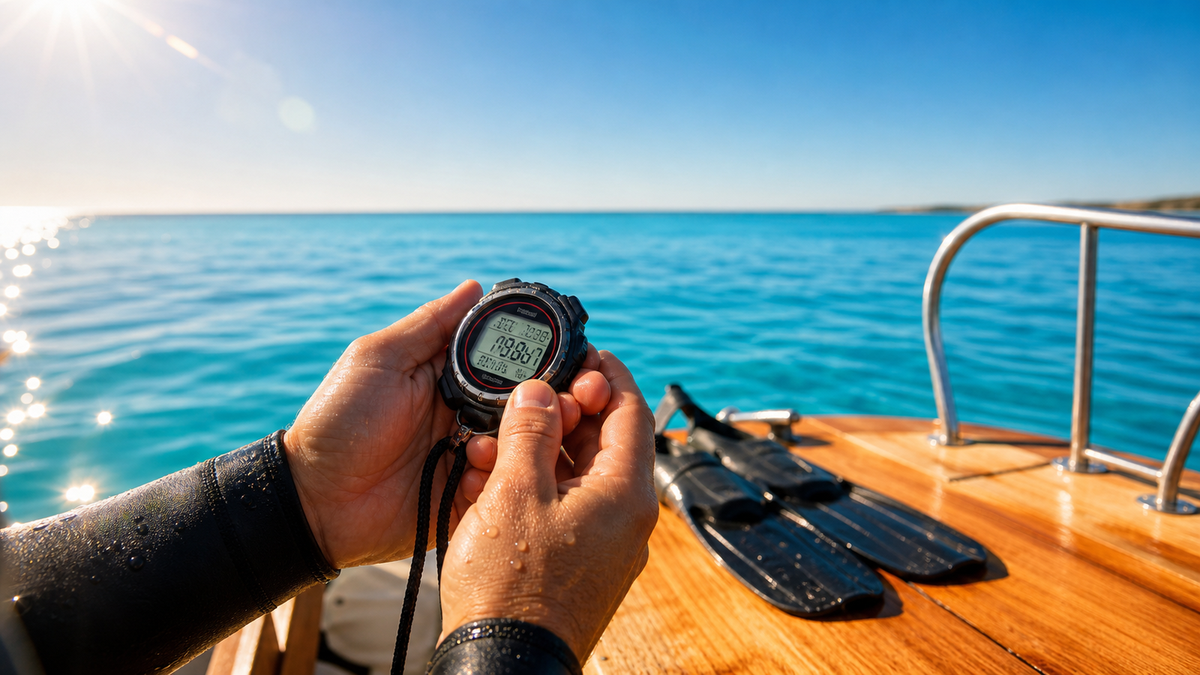
A CO₂ table is a series of breath holds of the same length separated by rests that get shorter every round. Because carbon dioxide builds up faster than your body can clear it, each hold starts with more CO₂ in your blood than the one before — and that is exactly the stimulus that trains your tolerance to the urge to breathe. It is dry-land training, it takes about 20 minutes, and it is the single most reliable way to make a breath hold feel calmer.
Key takeaways
- The urge to breathe is triggered by rising carbon dioxide, not by falling oxygen. Training it means training your response to a chemical alarm, not your lung capacity.
- A CO₂ table holds the breath-hold time constant and shortens the rest every round, so each hold starts with more CO₂ than the last.
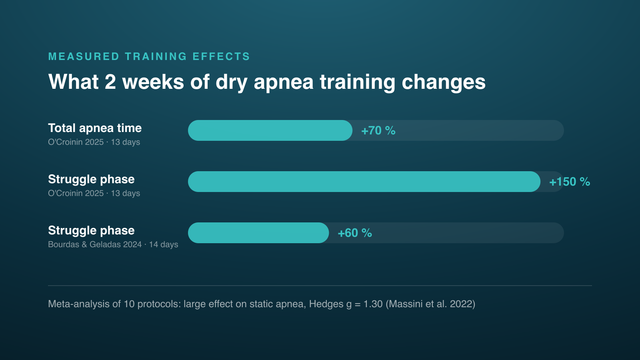
- Two weeks of daily dry holds raised total apnea time by 70 percent in beginners (O’Croinin et al., 2025) — and nearly all of the gain came from the uncomfortable struggle phase, not the easy one.
- Never hyperventilate before a hold, and never train in or near water alone. Blowing off CO₂ removes the warning without adding useful oxygen.
What is CO₂ tolerance, really?
CO₂ tolerance is how much of a rise in blood carbon dioxide you can stay calm through before you have to breathe. It is not lung size and not oxygen storage.
Most people assume that the burning need to inhale comes from running out of oxygen. It does not. Your brainstem and the chemoreceptors in your carotid arteries watch the partial pressure of carbon dioxide in your blood. When it climbs a few millimetres of mercury above your resting value — often just 3 to 5 mmHg — the drive to breathe switches on. Your oxygen saturation at that moment is still high enough to run a marathon.
That gap between “I want to breathe” and “I need to breathe” is where all breath-hold training happens. You are not training your lungs to hold more air. You are training your nervous system to stay calm while a chemical alarm is ringing.
This has one practical consequence that matters more than anything else on this page: never hyperventilate before a hold. Blowing off CO₂ silences the alarm without adding any meaningful oxygen. You feel great, you hold longer, and you may lose consciousness with no warning at all. Every safe protocol works with the CO₂ signal, not against it.
The two phases of a breath hold
Swedish physiologist Erika Schagatay’s terminology splits a hold into two parts, and it is the most useful mental model you can carry into training:
- The easy-going phase is the stretch from the start of the hold until the first involuntary contraction of your diaphragm. It feels like nothing much is happening.
- The struggle phase is everything after that first contraction, until you break. Contractions get stronger and closer together. Nothing dangerous is happening yet; it is uncomfortable, not harmful.
Here is the striking part. O’Croinin and colleagues trained 22 beginners for 13 days, combining daily holds with deliberate psychological coaching. Total apnea time rose from 44 ± 21 s to 75 ± 33 s — a 70 % improvement (Applied Physiology, Nutrition, and Metabolism, 2025, DOI 10.1139/apnm-2025-0033). But the easy-going phase barely moved: 26 ± 12 s to 30 ± 17 s, statistically indistinguishable (p = 0.329). The struggle phase went from 18 ± 18 s to 45 ± 34 s.
Almost the entire gain came from tolerating discomfort longer, not from a physiological change in the comfortable part of the hold. That is a training target you can practise deliberately — and CO₂ tables are the tool.
How a CO₂ table is built
The structure is deliberately boring:
- Pick a hold time you can complete comfortably in every round — roughly 50–60 % of your current maximum.
- Keep that hold constant for all 8 rounds.
- Start with a long rest (around 2:00) and shorten it every round, down to about 0:35–0:45.
Because the rest shrinks, you enter each hold with progressively less CO₂ cleared from the previous one. Round 1 feels trivial. Round 7 feels like a maximum attempt at half the duration. That is the point.
Enter your own maximum below and the generator builds the table for you:
Build your CO₂ table
Enter your current maximum breath hold. The table keeps the hold constant at 50–60 % of your max and shortens the rest each round — that is what trains CO₂ tolerance.
| Round | Rest | Hold |
|---|---|---|
| 1 | 2:00 | 0:35 |
| 2 | 1:50 | 0:35 |
| 3 | 1:35 | 0:35 |
| 4 | 1:25 | 0:35 |
| 5 | 1:10 | 0:35 |
| 6 | 1:00 | 0:35 |
| 7 | 0:50 | 0:35 |
| 8 | 0:35 | 0:35 |
Total session: 15:05
Dry, seated or lying down, no hyperventilation. Stop the table if you feel dizzy or get strong contractions early.
The full session lands somewhere around 15–20 minutes. Do it dry, sitting or lying down, once or twice a day. There is no need to do it in water, and every reason not to.
Three schools: classic, Wonka and no-contraction
Not everyone runs the same table, and the differences are worth understanding.
The classic table is what the generator above produces: fixed hold, shrinking rest. It is predictable, easy to log, and progresses cleanly — when the last round stops feeling hard, raise the hold by 5–10 seconds and start again.
The Wonka table keeps the rest fixed and lengthens the hold instead. Fans argue it trains a rising CO₂ load with a stable recovery, which feels more like real diving, where surface intervals are dictated by conditions rather than by a plan. It is harder to pace: the last rounds can turn into maximum attempts if you started too high.
The no-contraction approach flips the goal entirely. Rather than pushing deep into the struggle phase, you end every hold at the first contraction. Sessions are short, recovery is fast, and there is no accumulation of stress. It is the safest way to train frequently, and a sensible default if you train alone, are new to apnea, or are training in the days before a dive trip.
There is no single winning protocol, and that is not hand-waving — it is what the measurements show. The meta-analysis by Massini and colleagues pooled 10 protocols from 8 studies and found a large effect on static apnea time (Hedges g = 1.30, 95 % CI 0.85–1.76, p < 0.01). That held across pure breath-hold work, physical training and cross-training alike, and the authors could not single out one ideal method (Journal of Sports Medicine and Physical Fitness, 2022; PROSPERO CRD42021230322). Worth knowing about the methodology before you lean on it: the pooled sample size is only 138 participants across all eight studies, which is small for a field this noisy. The practical reading is still clear enough — consistency and progression matter far more than which table you pick.
What the science says about how fast this works
Three data points are worth memorising:
| Study | Protocol | Result |
|---|---|---|
| O’Croinin et al. 2025 | 13 days, beginners | Total apnea time +70 %; struggle phase 18 → 45 s; diving bradycardia deepened from −10 to −20 bpm |
| Bourdas & Geladas 2024 | 14 days, dry apnea | Struggle phase +59.7 % on average (PMID 37797907) |
| Engan et al. 2013 | 14 days, untrained | Diving bradycardia arrived ~3 s earlier; desaturation slower — nadir SpO₂ 84 % vs 89 % at matched hold duration |
Two weeks. That is the timescale. Notice also what did not change in the Engan study: haematocrit and haemoglobin were unmoved after two weeks (Scandinavian Journal of Medicine & Science in Sports, 2013, 23:340–348). If someone tells you that a fortnight of breath holds gives you an EPO-like blood boost, the measurement says otherwise. The early gains are neural, autonomic and psychological — for example, the same protocol that added 27 seconds to the struggle phase left the blood values exactly where they started.
There is a bonus finding in the O’Croinin data that has nothing to do with diving. The participants’ heart-rate response to a Stroop test — an unrelated cognitive stressor — was blunted after training, from 10 ± 7 to 6 ± 5 bpm (p = 0.009). Training your response to the urge to breathe appears to generalise to how you handle stress in general.
Safety rules that are not optional
- Never hyperventilate. More than 2–3 slow, relaxed breaths before a hold is already too many.
- Train dry. Sitting or lying on a soft surface, on land. Every table on this page is a dry protocol.
- Never in or near water alone. A hypoxic blackout is silent, gives no warning, and a face-down swimmer drowns in minutes.
- Skip the session if you are ill, dehydrated, sleep-deprived or hungover. Your numbers will be worse and your judgement will be too.
- Contractions are normal. Dizziness, tingling lips and tunnel vision are not. Stop and breathe.
How to progress over weeks
Keep it simple:
- Re-test your maximum every two weeks, not more often. Max attempts are stressful and tell you little day to day. Between them, a weekly BOLT score costs 30 seconds and tracks the same tolerance from the comfortable end.
- Raise the hold by 5–10 seconds when the final round of the table stops feeling like a challenge. For example, if you built the table on a 2:00 maximum and round 8 at 1:10 now feels routine, move to 1:15–1:20 and start the cycle again.
- Alternate. CO₂ tables 3–4 days a week are plenty; add apnea walks for a movement-based CO₂ stimulus, and keep one day fully off.
- Log everything. The trend across weeks is the only number that matters.
If you do not know your starting point yet, run the free interactive baseline test first — the table above is only as good as the maximum you feed it.
Sources
- O’Croinin, O. et al. (2025). Applied Physiology, Nutrition, and Metabolism. DOI 10.1139/apnm-2025-0033
- Bourdas, D. I. & Geladas, N. D. (2024). Respiratory Physiology & Neurobiology 319:104168. PMID 37797907
- Engan, H. et al. (2013). Scandinavian Journal of Medicine & Science in Sports 23:340–348. PMID 23802288
- Massini, D. A. et al. (2022). Journal of Sports Medicine and Physical Fitness 62. PROSPERO CRD42021230322.
Every source above links to its abstract, and each link was opened and re-read against this text during the last editorial pass. Where a study measured trained athletes rather than beginners, for example, the article says so instead of generalising.
Written by Jan Luther — keen amateur freediver, and the developer behind Apnea Trainer since 2010. About this blog explains how sources are chosen; the imprint has the contact details for corrections. All articles
Frequently asked
How long does it take before a CO₂ table works?
Two weeks of consistent dry training is enough to see a measurable change. In O'Croinin et al. (2025), 13 days of daily holds raised total apnea time by 70 percent in beginners, and almost all of that gain came from tolerating the struggle phase longer rather than from a longer comfortable phase.
How often should I do a CO₂ table?
Three to four sessions a week is plenty, with at least one full rest day. A table is a nervous-system stimulus, not a muscle workout, and doing it daily tends to make sessions worse rather than better.
What hold time should I start with?
Roughly 50 to 60 percent of your current maximum breath hold, kept constant across all eight rounds. If you do not know your maximum, run a relaxed baseline test first — the table is only as good as the number you feed it.
Is it dangerous to train CO₂ tolerance?
Dry, seated or lying down, and without hyperventilation, a CO₂ table is one of the safer breath-hold protocols — the contractions are uncomfortable, not harmful. It becomes dangerous in or near water, or if you hyperventilate first, because a hypoxic blackout gives no warning.

Apnea Trainer is a breath-hold training app for iPhone, Apple Watch and Android. It guides you through timed breathing cycles and builds progressive tables around your personal bests. On Apple Watch the whole session runs on your wrist — live heart rate and haptic cues for every phase.
Keep reading

Find Your Breath-Hold Baseline: A Free Interactive Test (No Water Needed)
Before you train, measure. A guided dry test — paced breathing, one relaxed max hold — and an honest reading of what your result means.
What Science Says About Breath-Hold Training: 4 Studies in Plain English
Four peer-reviewed studies, no hype: what breath-hold training actually changes, how fast, and which popular claims the measurements refuse to back.