
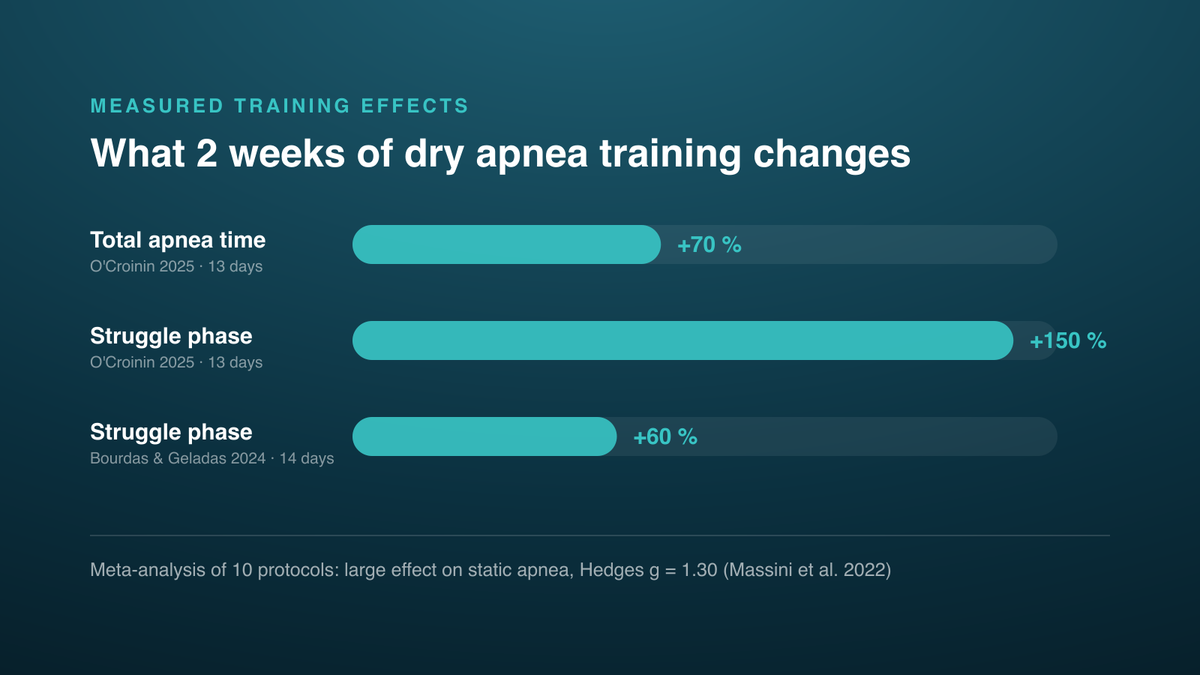
Yes, breath-hold training works, and the timescale is about two weeks. Across the peer-reviewed literature, dry apnea training produces a large effect on static breath-hold time (Hedges g = 1.30), improves the dive response, slows oxygen desaturation — and does most of its early work psychologically rather than haematologically. Here are the four studies worth knowing, what each measured, and what none of them found.
Key takeaways
- Dry apnea training has a large, replicated effect on static breath-hold time: Hedges g = 1.30 across 10 protocols from 8 studies.
- The timescale is roughly two weeks. Two separate training studies both reported large changes after a fortnight of daily holds.
- The gain sits in the struggle phase, not the comfortable one. The struggle phase is the stretch between the first involuntary contraction and the moment you break.
- What did not change: haematocrit and haemoglobin were flat after two weeks. Breath holds are not a shortcut to an altitude-training blood profile.
1. O’Croinin et al. 2025 — +70 % in 13 days, almost all of it mental
Twenty-two beginners trained for 13 days, combining breath holds with deliberate psychological coaching (Applied Physiology, Nutrition, and Metabolism, 2025, DOI 10.1139/apnm-2025-0033).
| Measure | Before | After | p |
|---|---|---|---|
| Total apnea time | 44 ± 21 s | 75 ± 33 s | < 0.001 |
| Easy-going phase | 26 ± 12 s | 30 ± 17 s | 0.329 |
| Struggle phase | 18 ± 18 s | 45 ± 34 s | < 0.001 |
| Diving bradycardia | −10 ± 11 bpm | −20 ± 13 bpm | < 0.001 |
| HR response to Stroop test | 10 ± 7 bpm | 6 ± 5 bpm | 0.009 |
Read the second row again. The comfortable part of the hold did not significantly change. All of the visible progress came from the struggle phase, which more than doubled. Whatever training did to these participants, it mostly changed their relationship to discomfort.
The last row is the sleeper finding. A Stroop test is a standard cognitive stressor — you name the colour a word is printed in while the word itself spells a different colour — and it has nothing to do with breathing. The participants’ heart-rate reaction to it was blunted after two weeks of apnea training. That is a transfer effect: the skill did not stay in its box.
2. Bourdas & Geladas 2024 — novices versus elite
Ten novices and eleven elite apneists did two weeks of dry apnea training (Respiratory Physiology & Neurobiology 319:104168; PMID 37797907).
Daily maximal apneas lengthened the struggle phase by an average of 59.7 %. The comparison group matters here. The physiological breakpoint is the moment at which chemoreceptor signalling would make an untrained person inhale, and trained divers can suppress the drive well past it. That capacity is trainable, and the gap between novice and elite is largely a tolerance gap rather than a lung-capacity gap.
3. Engan et al. 2013 — the dive response gets faster, the blood does not change
Untrained participants trained daily for two weeks (Scandinavian Journal of Medicine & Science in Sports, 2013, 23:340–348). Two findings:
- Diving bradycardia set in about 3 seconds earlier. The heart-rate drop that conserves oxygen arrived sooner in the hold.
- Desaturation was slower. At matched hold duration and similar lung volume, nadir SpO₂ was 84 % before training versus 89 % after — the same hold cost less oxygen.
And the negative result, which is arguably the most useful thing in this whole article: haematocrit and haemoglobin did not change over two weeks. The popular story that a couple of weeks of breath holds gives you an EPO-like blood boost is not supported. Spleen contraction and long-term altitude-style adaptations are separate questions on separate timescales; two weeks of dry tables are not doing that.
4. Massini et al. 2022 — the meta-analysis
A systematic review and meta-analysis (PROSPERO CRD42021230322) pooled 10 protocols from 8 studies, 138 participants (Journal of Sports Medicine and Physical Fitness, 62).
The effect on static apnea time was large: Hedges g = 1.30, 95 % CI 0.85–1.76, p < 0.01. Three families of method — pure breath-hold work, physical training, and cross-training — all produced improvements, and the analysis could not identify a single ideal protocol.
That last sentence is not a disappointment; it is a design brief. If no protocol is universally best, then the right protocol is the one that fits your baseline, your schedule and your recovery. For example, someone training four mornings a week before work and someone training twice a week after a long shift should not be running the same table, even at the same baseline — which is the argument for a plan that adapts to the individual rather than a fixed table copied from a forum.
What this means for your training
6-week progression preview
Drag your baseline and see how a progressive plan scales the hold each week. The app builds and adapts this automatically.
| Week | Target hold | Focus |
|---|---|---|
| 1 | 1:05 | Relaxation & breathe-up |
| 2 | 1:10 | CO₂ tolerance, short rests |
| 3 | 1:15 | CO₂ tolerance, longer holds |
| 4 | 1:20 | Struggle-phase tolerance |
| 5 | 1:25 | Mixed CO₂ / O₂ work |
| 6 | 1:30 | Max attempt & deload |
Scaling used here: hold = baseline × (1 + 0.09 × week)
Four practical conclusions:
- Expect movement in 2–6 weeks. Both training studies with a fortnight of work showed large changes. If six weeks of consistent training produce nothing, the variable to check is consistency, not genetics.
- Train the struggle phase, not the easy phase. The easy-going phase is largely fixed in the short term. Tolerance is where the gains live — which is what CO₂ tables are for.
- Psychology is not a soft add-on. In the one study that explicitly coached it, the psychological component carried the result. The relaxation half of that skill is what yogic breath retention has been drilling for centuries.
- Measure the same way every time. Effect sizes this large are easy to lose in noisy measurement. Use a repeatable baseline test .
What the evidence does not say
Being clear about the limits is part of taking the evidence seriously:
- It does not say breath-hold training is safe in water without supervision. None of these protocols were dry-by-accident.
- It does not show a blood-oxygen-carrying improvement in two weeks (Engan measured the opposite).
- It does not identify one best protocol (Massini looked and could not find one).
- Sample size is the weak point across the board — 10 to 22 participants per study, 138 pooled. The effects are large and consistent, but this is a young literature, and the methodology varies enough between studies that pooling them is itself a judgement call. Such as it is, the direction is clear; the precision is not.
Sources
- O’Croinin, O. et al. (2025). Applied Physiology, Nutrition, and Metabolism. DOI 10.1139/apnm-2025-0033
- Bourdas, D. I. & Geladas, N. D. (2024). Respiratory Physiology & Neurobiology 319:104168. PMID 37797907
- Engan, H. et al. (2013). Scandinavian Journal of Medicine & Science in Sports 23:340–348. PMID 23802288
- Massini, D. A. et al. (2022). Journal of Sports Medicine and Physical Fitness 62. PROSPERO CRD42021230322.
Every source above links to its abstract, and each link was opened and re-read against this text during the last editorial pass. Where a study measured trained athletes rather than beginners, for example, the article says so instead of generalising.
Written by Jan Luther — keen amateur freediver, and the developer behind Apnea Trainer since 2010. About this blog explains how sources are chosen; the imprint has the contact details for corrections. All articles
Frequently asked
Does breath-hold training actually work?
Yes, and the effect is large. A meta-analysis of 10 protocols from 8 studies found a Hedges g of 1.30 (95 percent CI 0.85 to 1.76) on static apnea time. Three different families of method all produced gains, and no single protocol came out ahead.
How long before I see results?
About two weeks. Two independent training studies using roughly a fortnight of daily dry holds both reported large changes — a 70 percent rise in total apnea time in one, and a 59.7 percent longer struggle phase in the other.
Does breath-hold training increase haemoglobin like altitude training?
Not on this timescale. Engan et al. (2013) measured haematocrit and haemoglobin before and after two weeks of daily training and found no change. The early gains are autonomic and psychological, not haematological.
Which part of the hold improves with training?
The uncomfortable part. In O'Croinin et al. (2025), the easy-going phase before the first contraction barely moved (26 to 30 seconds, p = 0.329), while the struggle phase went from 18 to 45 seconds.

Apnea Trainer is a breath-hold training app for iPhone, Apple Watch and Android. It guides you through timed breathing cycles and builds progressive tables around your personal bests. On Apple Watch the whole session runs on your wrist — live heart rate and haptic cues for every phase.
Keep reading
CO₂ Tables Explained: The Science of Training Your Urge to Breathe
The urge to breathe is a CO₂ alarm, not an oxygen alarm. Here is how CO₂ tables train that alarm — and how to build one from your current max.
Find Your Breath-Hold Baseline: A Free Interactive Test (No Water Needed)
Before you train, measure. A guided dry test — paced breathing, one relaxed max hold — and an honest reading of what your result means.