
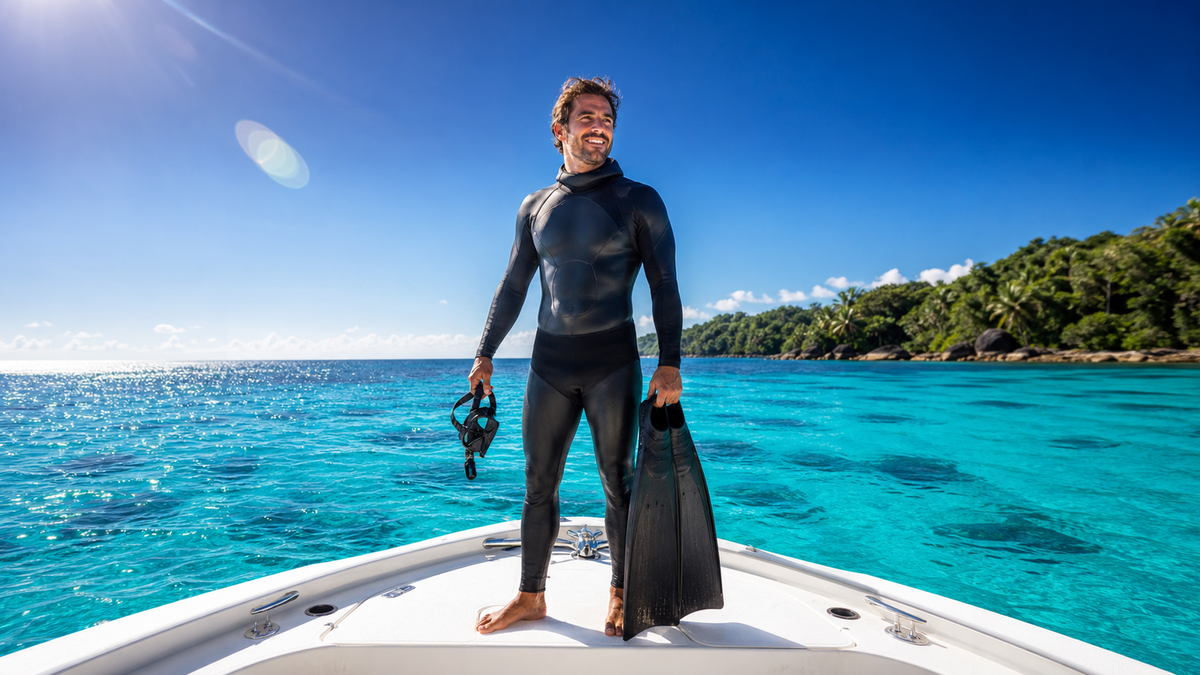
For most recreational spearfishing, a comfortable 90-second breath hold is plenty. The limiting factor is almost never lung volume — it is CO₂ tolerance, relaxation and how much oxygen you waste on the way down. All three improve with six weeks of dry training, no water required, and the measured effects are large.
Key takeaways
- A shallow hunt at 8 to 12 metres needs roughly 60 to 90 seconds in total. Chasing a three-minute static does not make you a better hunter.
- Bottom time is the stretch between arriving at depth and starting your ascent, and it is the only part of the dive that catches fish. It is limited by comfort, not by capacity.
- Six weeks of dry work is enough. Two independent studies found large changes in two weeks, and every protocol behind them was dry.
- In the water, none of this is negotiable: one up one down, a buddy watching for 30 seconds after every surface, and turning around on a plan rather than on a feeling.
How much bottom time do you actually need?
Count the dive, not the fantasy. A typical shallow-water hunt at 8–12 metres looks like this:
| Phase | Time |
|---|---|
| Duck dive and descent | 12–18 s |
| Bottom time (waiting, stalking, aiming) | 30–50 s |
| Ascent | 15–25 s |
| Buffer — non-negotiable | 20 s+ |
That totals 80–110 seconds. A relaxed 90-second static and a disciplined turn-around habit cover the overwhelming majority of recreational hunting. Chasing a four-minute static will not put more fish in the boat; it will just make your training week longer.
The far more valuable improvements are: arriving at the bottom already relaxed, not spending oxygen on tense shoulders and an over-fast finning cadence, and surfacing with a margin instead of at your limit.
Why CO₂ tolerance is the real limiter
The urge to breathe is triggered by rising carbon dioxide, not by a lack of oxygen — chemoreceptors in your brainstem and carotid bodies fire when CO₂ rises just 3–5 mmHg above your resting level. You are still comfortably oxygenated at that moment. What ends most dives early is the discomfort, not the physiology.
The research is unusually clear on this. In a 13-day beginner study, total apnea time rose 70 %, but the easy-going phase — before the first contraction — did not change significantly (26 → 30 s, p = 0.329). The struggle phase went from 18 to 45 seconds (O’Croinin et al., 2025, DOI 10.1139/apnm-2025-0033). Bourdas and Geladas measured a 59.7 % average increase in the struggle phase after two weeks of dry work (PMID 37797907).
Meanwhile, oxygen use itself gets more efficient: after two weeks of training, nadir SpO₂ at matched hold duration was 89 % instead of 84 %, and the diving bradycardia arrived about three seconds earlier (Engan et al., 2013).
Lung volume, by contrast, is largely fixed and mostly a function of your body. Total lung capacity is set by height, sex, age and the size of your thoracic cavity — it is the basis of every spirometry reference equation (Quanjer et al., 2012, PMID 22743675). Tolerance is trainable. Train the trainable thing.
The six-week dry plan
Set your baseline first — one relaxed maximum hold, dry, after two minutes of calm breathing (use the interactive baseline test ). Then the progression scales from that number:
6-week progression preview
Drag your baseline and see how a progressive plan scales the hold each week. The app builds and adapts this automatically.
| Week | Target hold | Focus |
|---|---|---|
| 1 | 1:05 | Relaxation & breathe-up |
| 2 | 1:10 | CO₂ tolerance, short rests |
| 3 | 1:15 | CO₂ tolerance, longer holds |
| 4 | 1:20 | Struggle-phase tolerance |
| 5 | 1:25 | Mixed CO₂ / O₂ work |
| 6 | 1:30 | Max attempt & deload |
Scaling used here: hold = baseline × (1 + 0.09 × week)
Week by week:
- Weeks 1–2 — foundation. Three CO₂ tables a week at 50 % of your max, ending every hold at the first contraction. Two easy apnea walks . The goal is habit and relaxation, not numbers.
- Weeks 3–4 — tolerance. CO₂ tables at 55–60 %, rests shortened. Push two or three rounds per session a little into the struggle phase. Apnea walks with slightly longer holds.
- Week 5 — mixed load. Keep one CO₂ session, add one session of longer holds with long rests (an O₂-style table). Re-test your baseline.
- Week 6 — taper. Volume down by about half, one relaxed maximum attempt at the end of the week, then rest before your first dive day.
Two rules that make or break the block: one full rest day every week, and skip any session where you are ill, dehydrated or badly slept. Breath-hold training is not the place to push through. Six weeks is a deliberate choice, not a round number: the methodology behind both training studies used roughly two-week blocks, and this plan stacks three of them so a re-test falls between each (O’Croinin et al., 2025; Bourdas & Geladas, 2024).
The four mistakes that cost the most
- Hyperventilating before a dive. A shallow-water blackout is a loss of consciousness near the surface caused by hypoxia, and it arrives without warning. Hyperventilation removes the warning signal without adding oxygen, which is the classic path to one. Two or three relaxed breaths, then go.
- Tension in the neck and shoulders. Free oxygen burn for no propulsion. On the descent, arms down, jaw loose, and let negative buoyancy do the work.
- Long surface holds before duck-diving. Time at the surface with a held breath is time spent for nothing. Breathe up, then commit.
- Diving until the alarm goes off. Turn around on a plan, not on a feeling. Your buffer is what makes the difference between a long career and a statistic.
Safety in the water — the part that is not negotiable
Dry training is safe if you follow the rules on this page. Water is different.
- Never dive alone. One-up-one-down, every dive, no exceptions.
- Your buddy must watch you for at least 30 seconds after you surface. Loss of motor control and blackouts usually happen at or just after the surface.
- Shallow-water blackout gives no warning. It is not preceded by a feeling of “almost too far”.
- Never breath-hold train in a pool without a trained buddy at arm’s length, and never in open water on your own.
- Weight yourself neutral or slightly positive at the surface.
None of the studies in this article were done in water for a reason. Do the tolerance work on land, and spend your water time diving well within a margin. For example, if your dry baseline is 2:30, a 60-second bottom time on a 12-metre dive still leaves you a wide buffer — and that buffer, not the baseline, is what keeps the sport boring in the good way.
Sources
- O’Croinin, O. et al. (2025). Applied Physiology, Nutrition, and Metabolism. DOI 10.1139/apnm-2025-0033
- Bourdas, D. I. & Geladas, N. D. (2024). Respiratory Physiology & Neurobiology 319:104168. PMID 37797907
- Engan, H. et al. (2013). Scandinavian Journal of Medicine & Science in Sports 23:340–348. PMID 23802288
- Massini, D. A. et al. (2022). Journal of Sports Medicine and Physical Fitness 62. PROSPERO CRD42021230322.
- Quanjer, P. H. et al. (2012). Multi-ethnic reference values for spirometry for the 3–95-yr age range. European Respiratory Journal 40:1324–1343. PMID 22743675
Every source above links to its abstract, and each link was opened and re-read against this text during the last editorial pass. Where a study measured trained athletes rather than beginners, for example, the article says so instead of generalising.
Written by Jan Luther — keen amateur freediver, and the developer behind Apnea Trainer since 2010. About this blog explains how sources are chosen; the imprint has the contact details for corrections. All articles
Frequently asked
How long do I need to hold my breath for spearfishing?
For most recreational shallow-water hunting at 8 to 12 metres, a comfortable 90-second hold is plenty. The dive itself is descent, 30 to 50 seconds of bottom time, and ascent — the limiting factor is comfort, not capacity.
Does lung volume matter for spearfishing?
Far less than people assume. Lung volume is largely fixed by your build, while CO₂ tolerance, relaxation and how much oxygen you waste on the descent are all trainable. Train the trainable thing.
Can I train for spearfishing without water?
Yes, and you should. Every study behind this plan used dry protocols. Dry CO₂ tables and apnea walks build the tolerance; water time is for diving well inside your margin, never for pushing it.
How long before the season should I start?
Six weeks is a full block — two weeks of foundation, two of tolerance work, one mixed week with a re-test, and one taper week before your first dive day.

Apnea Trainer is a breath-hold training app for iPhone, Apple Watch and Android. It guides you through timed breathing cycles and builds progressive tables around your personal bests. On Apple Watch the whole session runs on your wrist — live heart rate and haptic cues for every phase.
Keep reading

Apnea Walks: The Dry CO₂ Training You Can Do Anywhere
Movement makes CO₂ faster. Apnea walks turn that into the most time-efficient dry tolerance session there is — with a configurable interval timer.
CO₂ Tables Explained: The Science of Training Your Urge to Breathe
The urge to breathe is a CO₂ alarm, not an oxygen alarm. Here is how CO₂ tables train that alarm — and how to build one from your current max.